TouchPort: Allow Me Into Your Dream
2025-2026 Simon Fraser University
Author / Yilan Tao, Botao Amber Hu, Yue Li, Bernhard Riecke
Keywords / Colocated Mixed Reality, Soma Design, Consent
Contribution / Project Leader
Overview
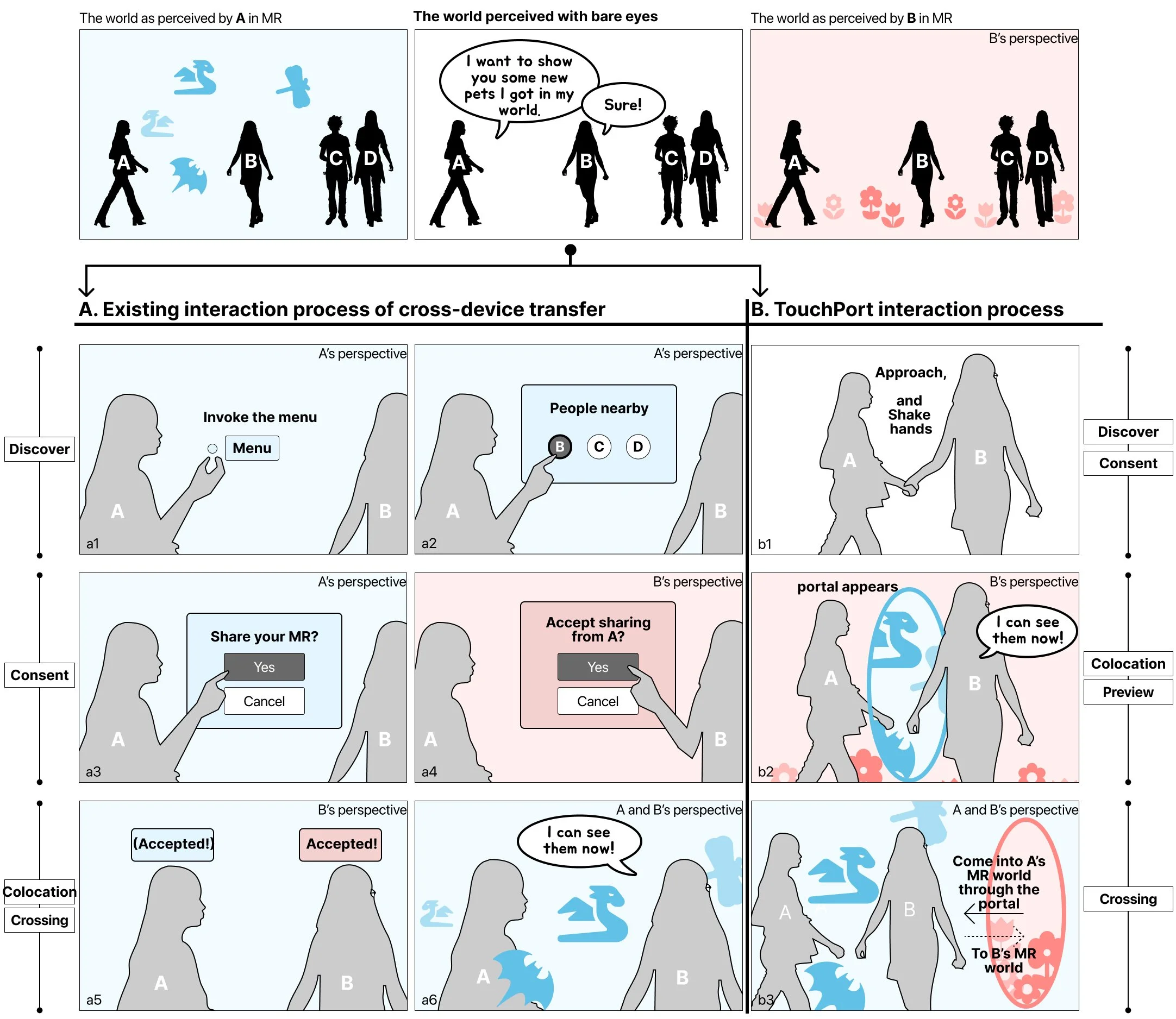
As mixed reality (MR) wearables approach mainstream adoption, we anticipate a future of fragmented realities in which each user inhabits an isolated augmented reality world---a personal ``dream'' invisible to everyone else. Today, sharing across these isolated ``dreams'' requires multiple steps of discovery, invitation, and consent through nested menus, undermining the immediacy of in-person encounters. We present TouchPort, an embodied protocol that reprograms the handshake---one of humanity's oldest social protocols---into a gestural interface for sharing mixed realities. When two MR wearers shake hands, a portal opens above their clasped hands, letting each peek into the other's world; a gentle pull then draws the guest into the host's space, while stepping back returns them to their own. These gestures embed discovery, consent, and entry in a simple, natural bodily movement. We demonstrate TouchPort through a recursive, multiplayer experiential-futures experience, ``Allow Me Into Your Dream,'' in which participants traverse each other's procedurally generated mixed reality ``dreams'' through a handshake, enabling spontaneous, consensual sharing in a future of fragmented realities.
Experience Design
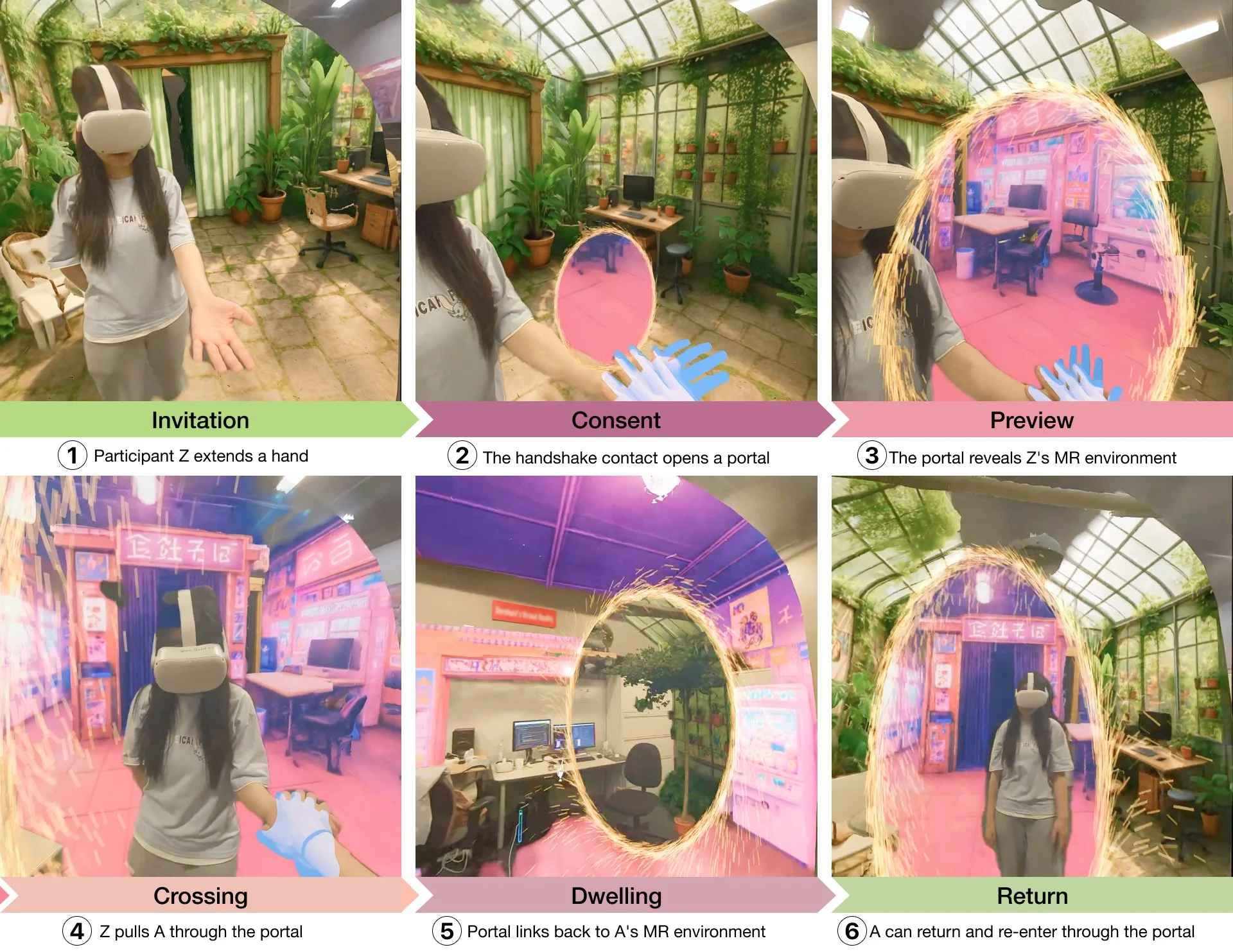
In this section, we detail the TouchPort protocol. The interaction unfolds in four stages:
Handshake.
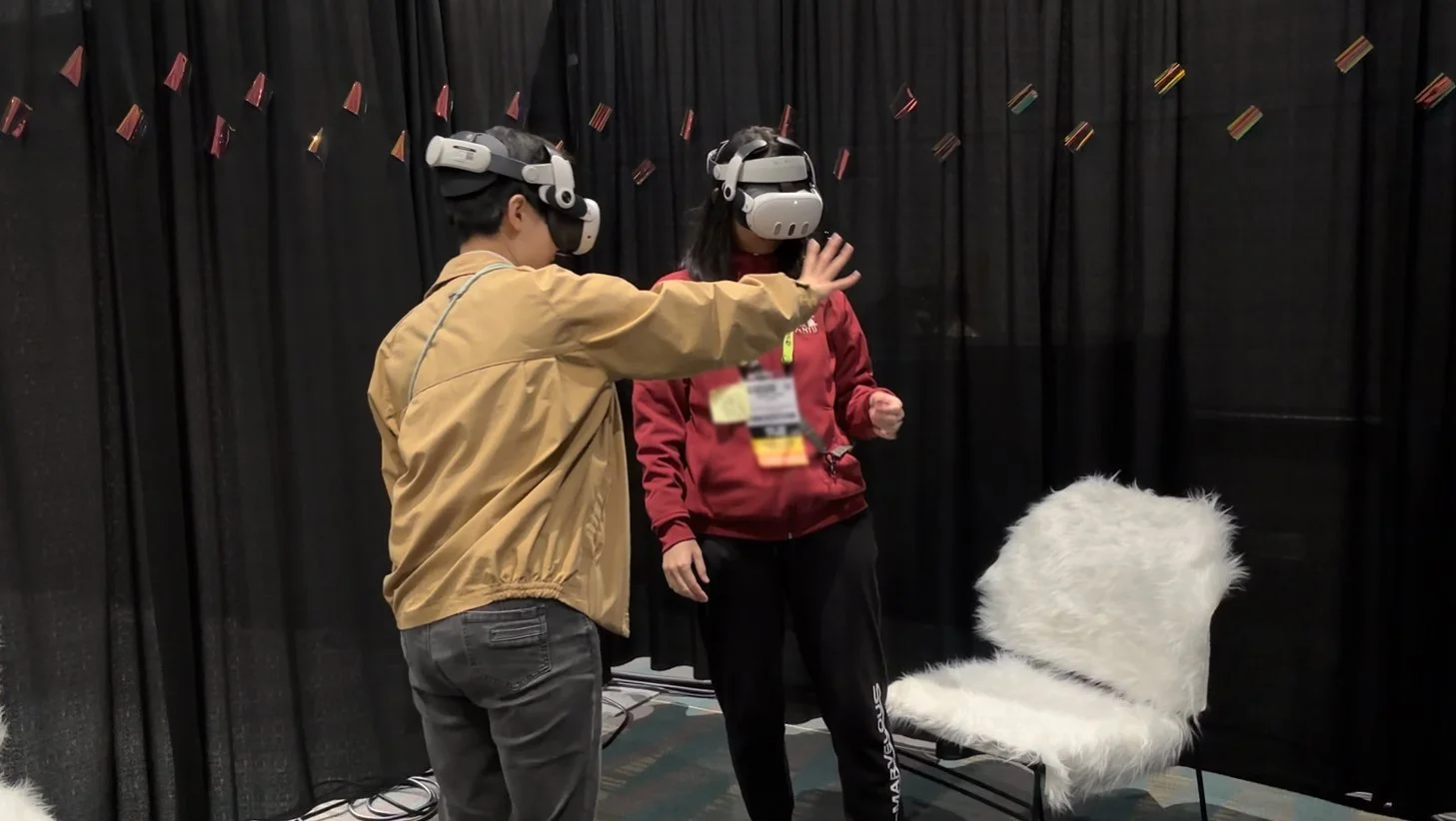
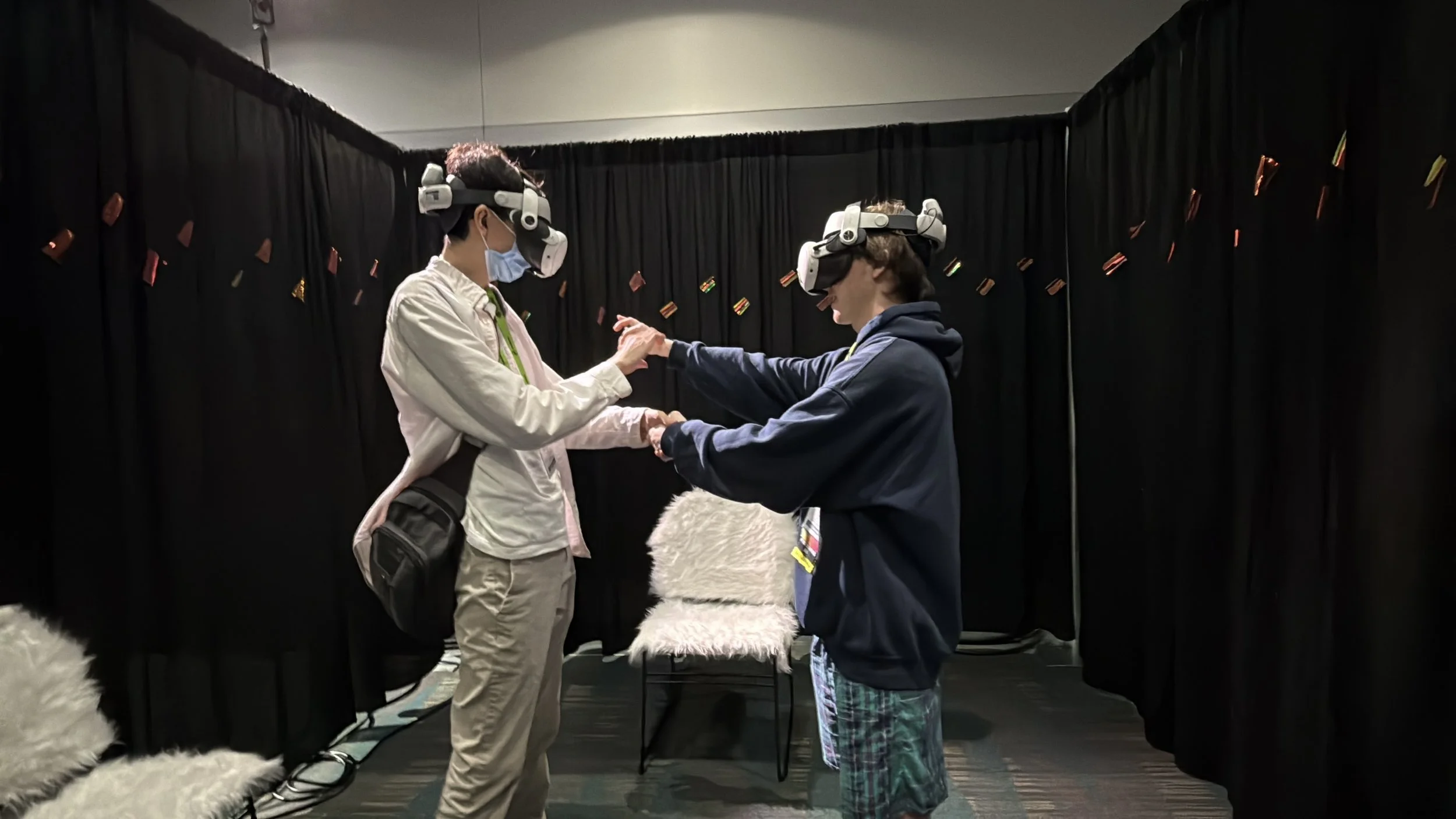
In TouchPort, the handshake is an opt-in discovery signal. Both users intentionally extend and clasp hands while wearing their MR headsets. Unlike a wireless broadcast like AirDrop that makes a user discoverable to anyone nearby, the handshake is a mutual agreement enacted in physical space: if one does not wish to share, they simply do not extend their hand. The moment of contact, detected simultaneously by both devices at the same place and time, signals that the two users want to connect. Discoverability is thus hyper-local and bound to an existing social gesture, minimizing accidental sharing and respecting privacy by default.
Portal Peek
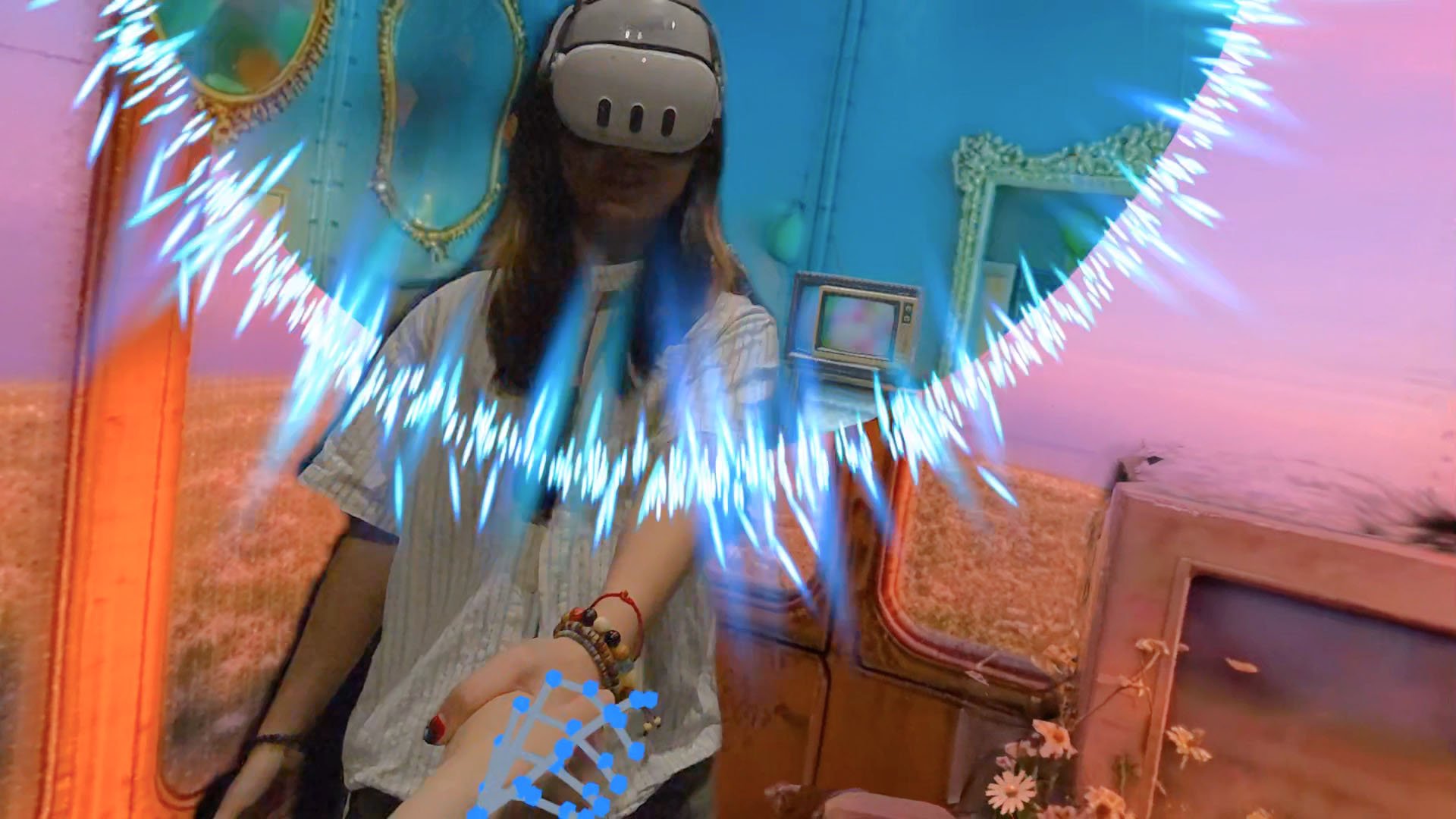
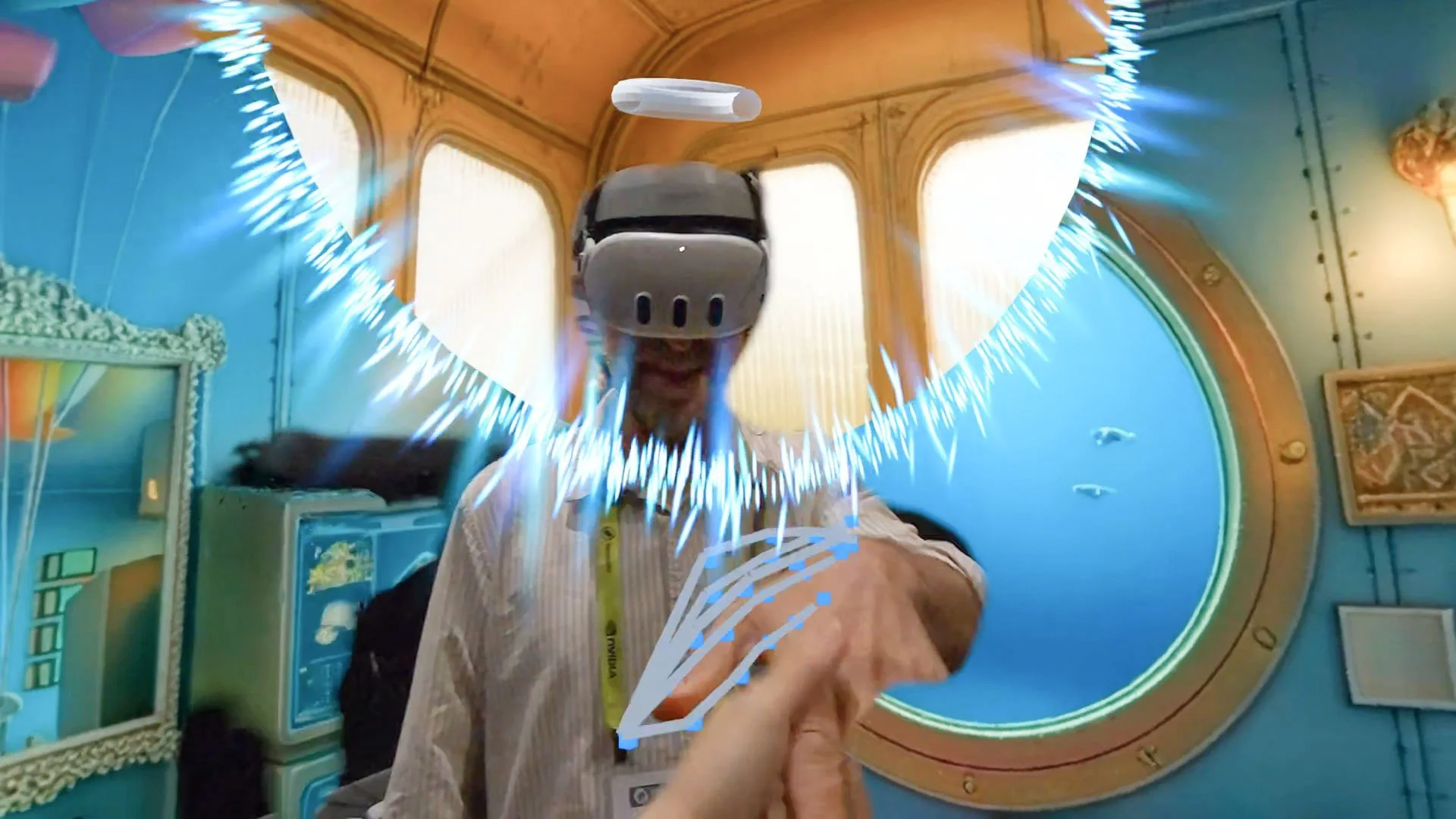
Upon a handshake, a circular portal opens above the clasped hands, visible to both users in passthrough. The portal is a window into the other person's MR layer: through it, each user catches a glimpse of the other's augmented world from their own side. We deliberately chose a partial, shared portal rather than an abrupt full-view switch \cite{Pointecker2022Transitioning}, so that users get a safe preview before committing to enter, much like peering through a doorway before stepping in. This stage is intentionally ephemeral and reversible: if either party feels uncomfortable, they can choose not to step in and stop the sharing at this point, avoiding being forced into an unfriendly immersive environment. Consent is continuously negotiated rather than granted by a single click.
Enter
If both users are comfortable after peeking, either one can escalate by gently pulling on the other's hand. This pull extends the greeting into an invitation. Upon detecting the pull and the approach, the interaction shifts from peeking to world-sharing: the portal becomes larger and lets the user step through entirely. After crossing through the portal, the guest's augmented surroundings transition into the host's world; to the guest, it feels as though they were drawn through the portal. The physical pull or walk is itself the confirmation, replacing any separate dialog or consent prompt and tightly coupling intention with action.
Exit
After releasing the handshake, the portal remains spatially anchored even after the user passes through it. The guest's previous reality is held on the other side throughout the visit, so returning to one's own MR world is as simple as stepping back through. Because exit is always available and physically grounded, the guest retains continuous control over how long they stay. To fully close the portal and end the sharing session, users can either shake hands again or tap a function-menu block on their right wrist to invoke a ``Stop Sharing'' button. We deliberately provide both an embodied option and a separate, explicitly controllable one since a guest may wish to exit without the host's agreement.
Credits
Concept: Botao Amber Hu, Yilan Elan Tao
Prototype and TA: Yilan Elan Tao
Research: Yilan Elan Tao, Botao Amber Hu
Instructor: Bernhard Riecke, Yue Li
Publication
Yilan Elan Tao, Botao Amber Hu*, Yue Li and Bernhard Riecke. 2026. Allow Me Into Your Dream: Sharing Mixed Realities through Handshakes. In Proceedings of the Special Interest Group on Computer Graphics and Interactive Techniques Conference Immersive Pavilion (SIGGRAPH Immersive Pavilion '26). Association for Computing Machinery, New York, NY, USA. https://doi.org/10.1145/3799823.381245